Global Railway Heritage Archive • 2026 Edition

The Definitive Historical Treatise on Locomotives, Permanent Way Engineering & World Rail Routes

Explore over 45,000 words of rigorous railway history, steam boiler thermodynamics, civil bridge mechanics, and transcontinental mountain passes authored by Lead Railway Historian Virgil Howell DDS.

Explore 20 Railway Monographs ↓ About Archive → Contact Desk →
Explore Categories: πŸš‚ Railway Development πŸš„ Historic Trains πŸŒ‰ Railway Engineering πŸ—ΊοΈ Famous Railway Routes βš™οΈ Railway Technology

The Railway How Loops and Zigzags Help Trains Climb the Mountains
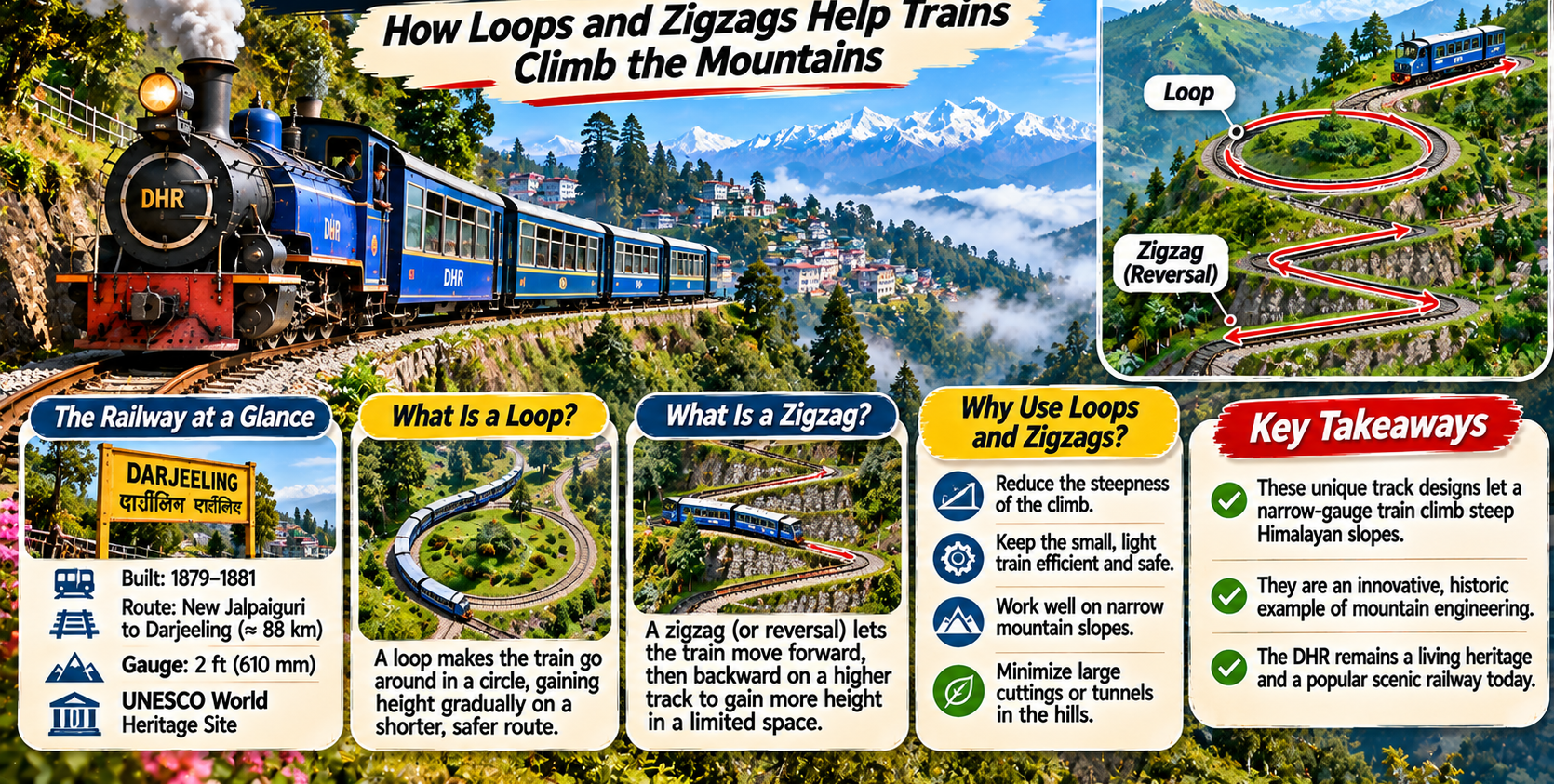
HIMALAYAN RAILWAY HERITAGE JOURNAL Β· MOUNTAIN ENGINEERING How a Tiny Mountain Railway Conquered the Steep Slopes of Darjeeling Discover how ingenious loops, reversing zigzags, and narrow-gauge engineering allowed trains to climb from the plains toward the Himalayan hill station of Darjeeling. MOUNTAIN RAILWAYS LOOPS & ZIGZAGS RAILWAY HERITAGE High in the hills of West Bengal, … Read more
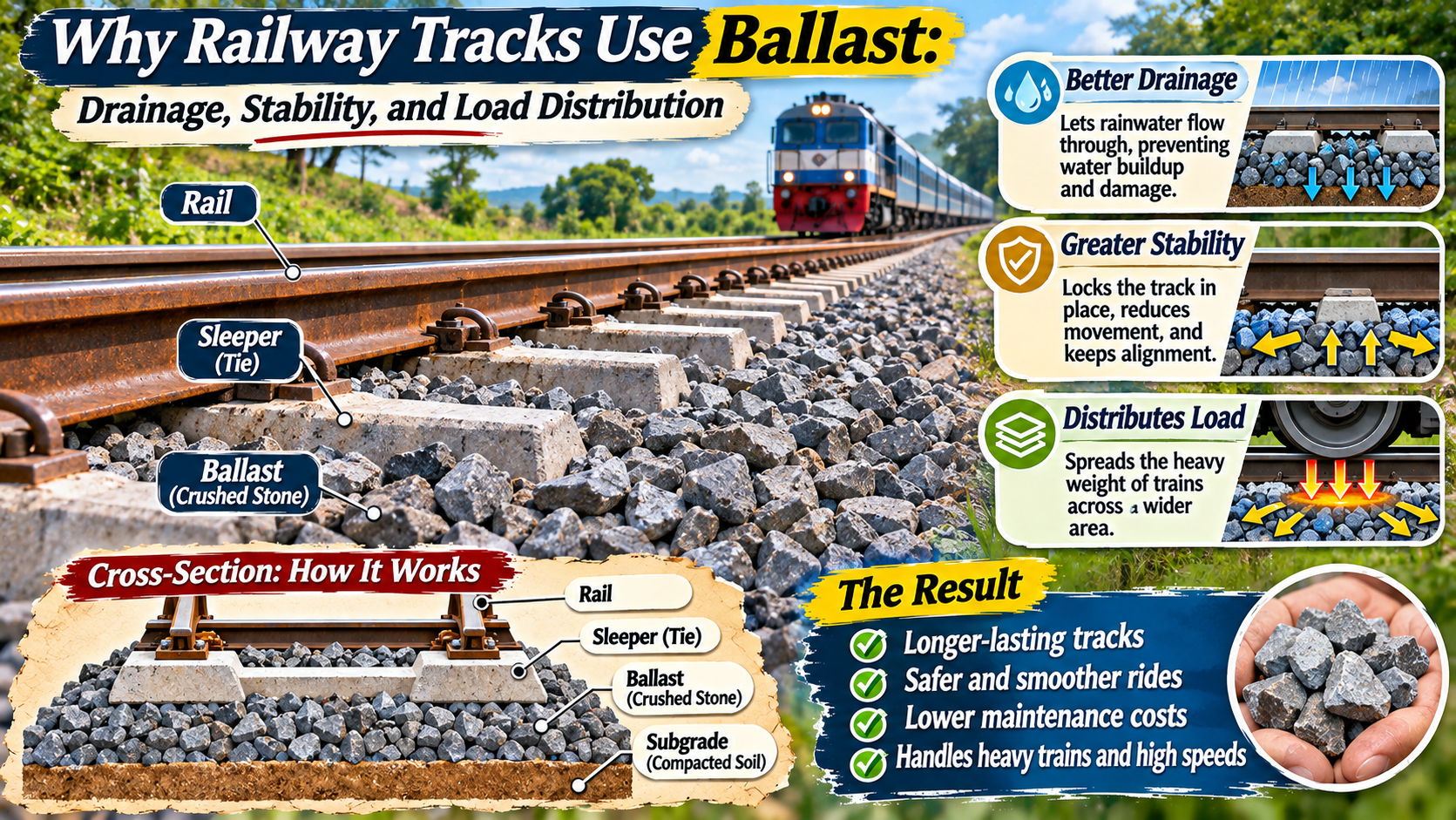
Why Railway Tracks Use Ballast Drainage, Stability, and Load Distribution

RAILWAY ENGINEERING / TRACK INFRASTRUCTURE The Engineering Beneath Every Railway Journey Discover why crushed stone supports railway tracks, how it manages water, and why its shape helps keep rails stable under repeated train loads. DRAINAGE TRACK STABILITY LOAD SUPPORT Look closely at a conventional railway track, and you will usually notice a thick layer of … Read more

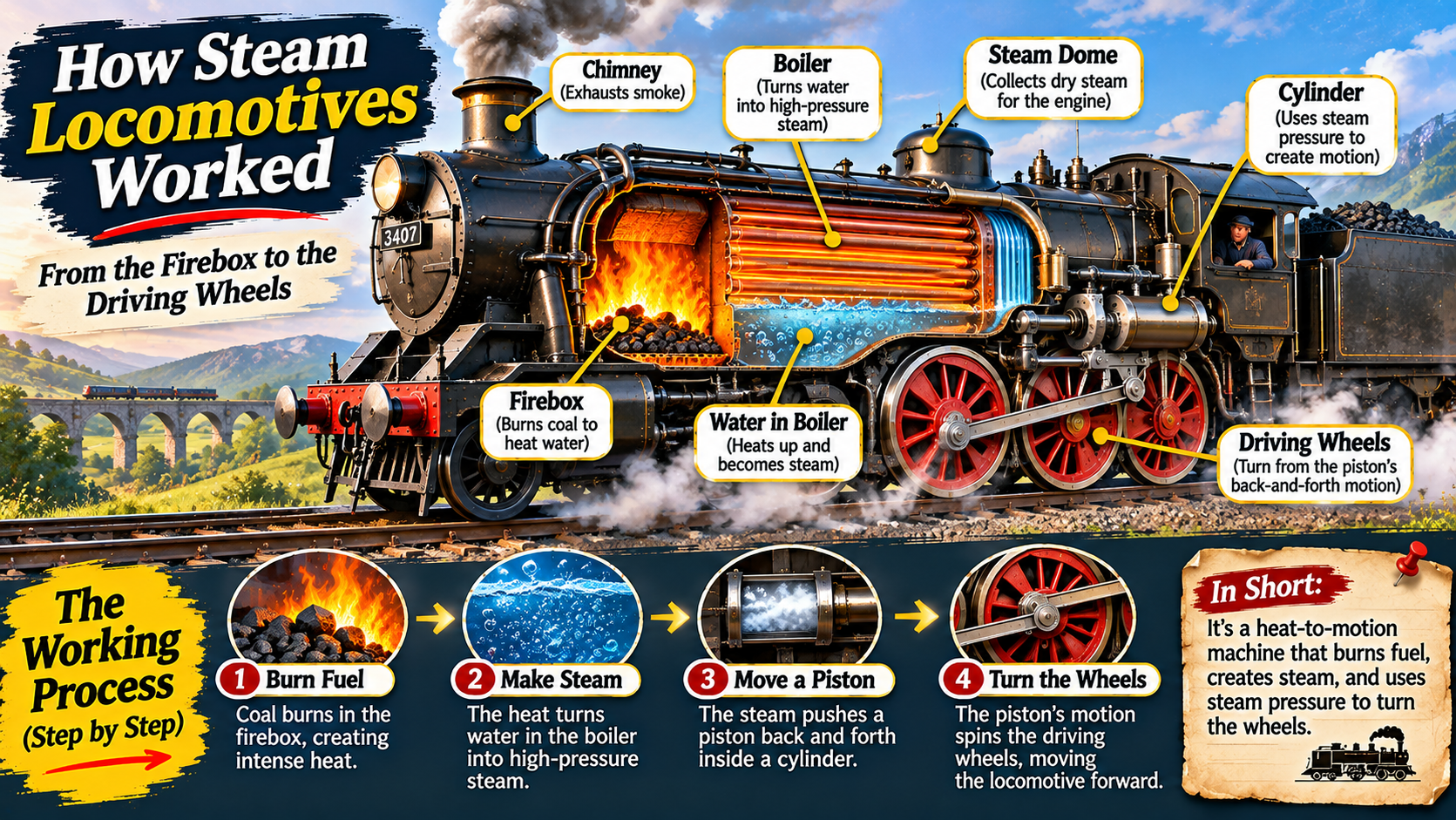
How Steam Locomotives Worked From the Firebox to the Driving Wheels

INDUSTRIAL ENGINEERING WORKSHOP Β· RAILWAY TECHNOLOGY Inside the Machine That Powered the Railway Age Follow the journey of heat, water, steam, and mechanical motion through one of history’s most influential machines. FIREBOXβ†’BOILERβ†’CYLINDERSβ†’DRIVING WHEELS A steam locomotive is one of the most recognizable machines of the Industrial Revolution. Its tall smokestack, powerful driving wheels, and rhythmic … Read more

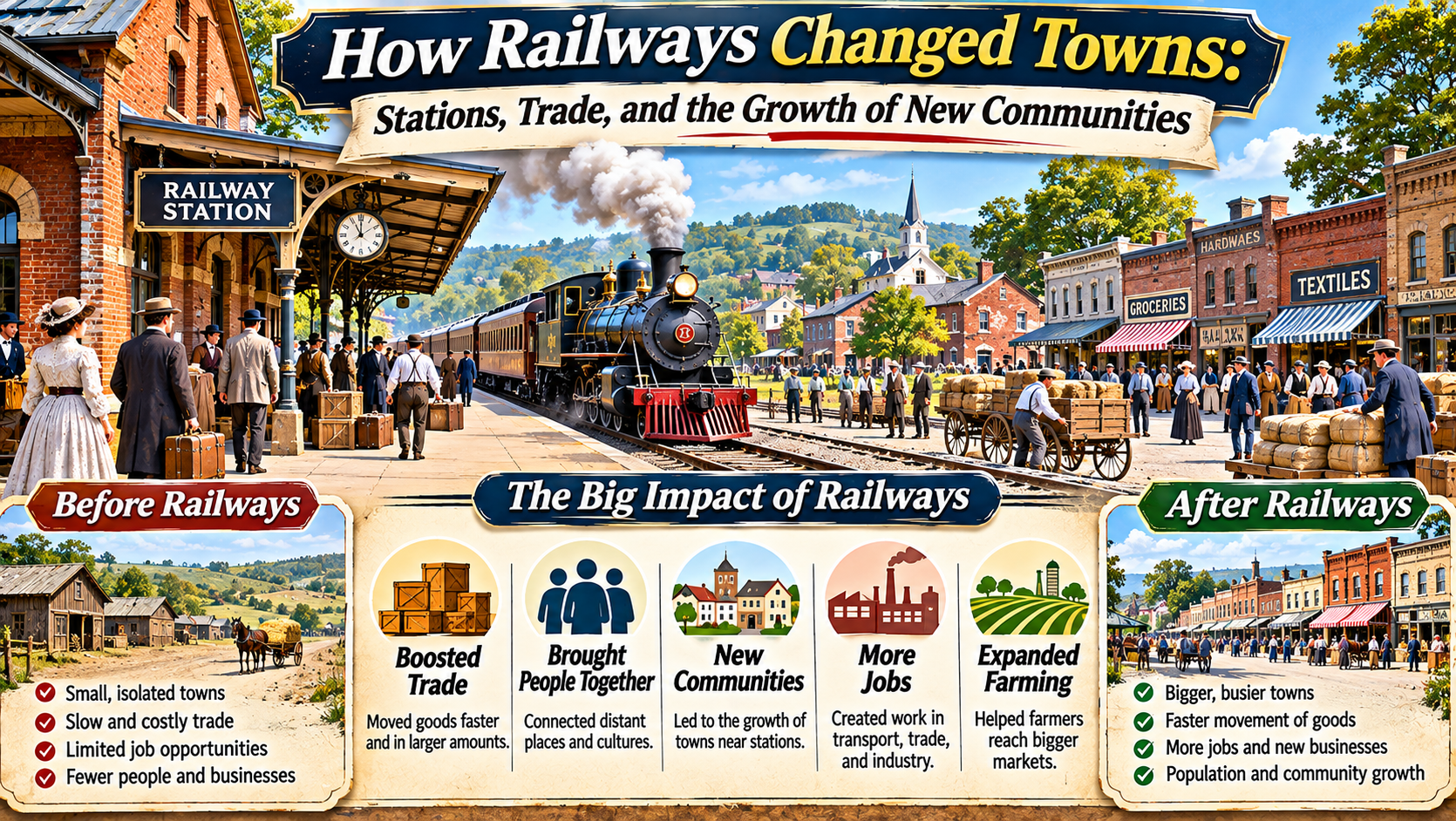
How Railways Changed Towns Stations, Trade, and the Growth of New Communities

RAILWAY HERITAGE JOURNAL / TRANSPORTATION & COMMUNITY HISTORY When the Railroad Arrived, Entire Towns Began to Change Explore how railway stations transformed local trade, attracted businesses, connected distant markets, and helped new communities grow during the industrial age. STATIONS   β—†   COMMERCE   β—†   NEW SETTLEMENTS   β—†   URBAN GROWTH Before railways … Read more

The Evolution of Railway Signalling: From Ball Signals and Absolute Block Working to Token Instruments and Track Circuits

Historic semaphore railway signal gantry guarding interlocking switches at a rail junction

Railway operations are fundamentally governed by a terrifying physical reality: a heavy train traveling at speed cannot steer around obstacles, and its braking distance vastly exceeds the visual sighting distance of the locomotive driver. In the dawn of the railway era, this geometric constraint led to horrifying rear-end and head-on collisions. To establish safe train … Read more

Westinghouse Air Brakes and Fail-Safe Pneumatics: The Friction Dynamics That Revolutionized Train Safety and Tonnage

Vintage railway triple valve pneumatic air brake assembly mounted beneath freight rolling stock

Of all the mechanical inventions that enabled the expansion of global railways, none was more consequential than the automatic air brake. Prior to the late 1860s, stopping a heavy train was a primitive, brutal, and lethal gamble. Trains were braked manually by teams of brakemen who sprinted across icy freight car rooftops to hand-crank manual … Read more

Steam Locomotive Boiler Thermodynamics: Fire-Tube Hydraulics, Superheating Elements, Injectors, and Stephenson Valve Gear

Cutaway view of a steam locomotive boiler showing firebox fire-tubes and superheater elements

A steam locomotive is essentially a high-pressure chemical and thermodynamic processing plant mounted upon a moving chassis. Operating under extreme spatial and dimensional constraints, its fire-tube boiler must generate thousands of pounds of superheated steam per hour from burning fossil fuels, transmitting immense thermal energy into mechanical tractive work at the railhead. From the combustion … Read more

The Bernina and Glacier Express: Narrow-Gauge Metric Engineering, Landwasser Viaduct, and UNESCO Alpine Crossings

Rhaetian Railway red train crossing the iconic curved stone Landwasser Viaduct into a cliff tunnel

Traversing the jagged peaks and glacier valleys of the Swiss Canton of GraubΓΌnden, the Rhaetian Railway (RhΓ€tische Bahn – RhB) and Matterhorn Gotthard Bahn (MGB) represent the supreme pinnacle of narrow-gauge mountain civil engineering on earth. Operating over an extensive metre-gauge (1,000 mm) network, these railways host two of the worlds most famous alpine journeys: … Read more

The Diesel-Electric and Electric Transition: Early Pioneers, Traction Motors, Pantograph Catenary Systems, and the Demise of Commercial Steam

Modern high-horsepower diesel-electric locomotive hauling heavy container freight across mainline tracks

Between 1935 and 1960, the global railway landscape underwent the most rapid, ruthless technological revolution in its history: the complete extinction of commercial steam traction and the triumph of the diesel-electric and electric locomotive. Despite a century of romantic affection and mechanical refinement, the steam locomotive was doomed by brutal thermodynamics: an overall thermal efficiency … Read more

The Trans-Siberian Railway: Engineering Across 9,289 Kilometers, Lake Baikal Ice Tracks, and Eurasian Geopolitics

Trans-Siberian train traversing the scenic rugged shoreline of Lake Baikal in Siberia

Stretching an astounding 9,289 kilometers (5,772 miles) across two continents, eight time zones, and the vast expanse of the Eurasian landmass, the Trans-Siberian Railway (Вранссибирская ΠΌΠ°Π³ΠΈΡΡ‚Ρ€Π°Π»ΡŒ) is the longest continuous railway corridor on earth. Authorized in March 1891 by Imperial Rescript of Tsar Alexander III and inaugurated under Tsarevich Nicholas (later Tsar Nicholas II), this … Read more