HIMALAYAN RAILWAY HERITAGE JOURNAL · MOUNTAIN ENGINEERING
How a Tiny Mountain Railway Conquered the Steep Slopes of Darjeeling
Discover how ingenious loops, reversing zigzags, and narrow-gauge engineering allowed trains to climb from the plains toward the Himalayan hill station of Darjeeling.
High in the hills of West Bengal, India, a narrow-gauge railway winds through steep slopes, mountain settlements, and dramatic Himalayan landscapes.
Known as the Darjeeling Himalayan Railway, this remarkable line has become famous for its small trains, historic steam locomotives, and unusual track arrangements.
But the railway is more than a scenic attraction.
It represents an important achievement in nineteenth-century mountain engineering.
Building a railway from the plains toward Darjeeling presented enormous challenges.
The route had to gain substantial elevation while crossing difficult terrain and navigating sharp curves.
Conventional railway construction would have required extensive earthworks, bridges, tunnels, or other costly infrastructure.
Instead, engineers developed a route that made clever use of the landscape.
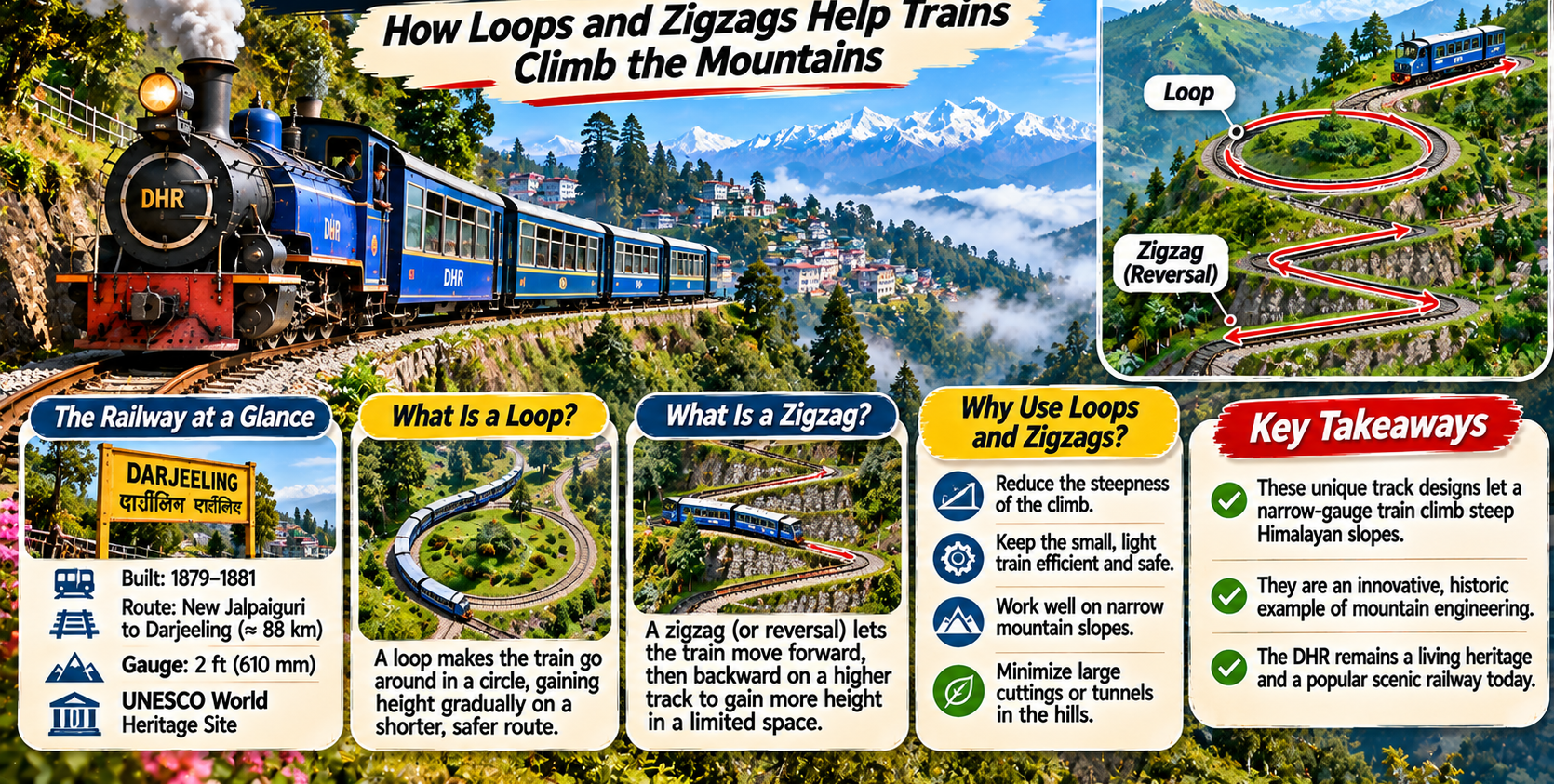
Loops and zigzags became essential features of the Darjeeling Himalayan Railway, allowing trains to gain height while keeping gradients within workable limits.
Understanding these techniques reveals how railway engineers adapted transportation technology to one of India’s most challenging mountain environments.
What Is the Darjeeling Himalayan Railway?
The Darjeeling Himalayan Railway is a historic narrow-gauge railway connecting the lower Himalayan foothills with Darjeeling.
Its traditional route runs between New Jalpaiguri and Darjeeling, with the historic mountain section associated with the original connection from Siliguri.
The railway uses a track gauge of approximately 610 millimeters, or two feet.
This narrow gauge allows smaller locomotives and rolling stock to negotiate tighter curves than many standard-gauge railway designs.
The railway opened in stages during the early 1880s, with the line reaching Darjeeling in 1881.
It was developed during a period when Darjeeling was becoming an important hill station and tea-growing region.
Rail transport offered a more efficient way to move passengers and goods between the plains and the mountains.
Today, the railway is widely known as the Darjeeling Toy Train.
It is also recognized internationally for its engineering and cultural significance.
Why Building a Railway to Darjeeling Was Difficult
Mountain railways face challenges that differ greatly from those encountered on flat terrain.
Trains cannot climb extremely steep slopes in the same way that road vehicles sometimes can.
Conventional railway locomotives depend on adhesion between their wheels and the rails.
As the gradient becomes steeper, more of the locomotive’s available tractive effort is needed simply to overcome gravity.
Steep gradients also create difficulties when trains descend because braking systems must control the movement safely.
In the Darjeeling region, engineers also had to consider unstable slopes, drainage, sharp turns, and limited space for track construction.
The terrain made a direct railway route impractical.
To overcome these obstacles, the railway needed to travel a longer distance while gradually gaining elevation.
This is where loops and zigzags became especially useful.
MOUNTAIN ENGINEERING PRINCIPLE
A Longer Railway Route Can Make a Steep Mountain Climb More Manageable.
By spreading elevation gain over a greater distance, engineers can reduce the average gradient that a train must overcome.
How Railway Gradients Work
A railway gradient describes how quickly the track rises or falls over a given horizontal distance.
Gradients are commonly expressed as ratios.
For example, a gradient of 1 in 30 means the track rises approximately one unit vertically for every 30 units traveled horizontally.
A smaller denominator represents a steeper slope.
Mountain railways often require careful gradient management because locomotives have limited adhesion and pulling power.
The Darjeeling Himalayan Railway includes demanding gradients and numerous sharp curves.
Its route demonstrates how engineering techniques can help conventional adhesion trains operate in steep terrain without relying on a rack-and-pinion system.
However, the railway’s operation still requires suitable locomotives, controlled speeds, and careful management of track conditions.
What Is a Railway Loop?
A railway loop is a section of track that curves around to gain elevation while continuing the journey in the intended general direction.
In mountainous terrain, a loop allows the railway to cover additional distance within a limited area.
Instead of climbing directly up a steep slope, the train follows a curved route that gradually increases its height.
This reduces the need for an excessively steep direct alignment.
Loops are particularly useful where the terrain provides enough space for a curved track arrangement.
The Darjeeling Himalayan Railway includes several historic loops that demonstrate this principle.
Some have become famous landmarks because of their unusual shape and dramatic mountain views.
Batasia Loop: The Railway’s Most Famous Curve
Batasia Loop is one of the best-known features of the Darjeeling Himalayan Railway.
Located near Darjeeling, it allows the railway to negotiate a difficult section of mountain terrain through a sweeping curved alignment.
The loop provides a longer track path within a relatively compact area.
This helps the railway manage elevation changes while maintaining a workable gradient.
The location has also become a popular viewpoint.
On clear days, visitors may see dramatic Himalayan scenery, including views toward Kangchenjunga.
Although Batasia Loop is celebrated for its appearance, its original purpose was practical engineering.
It demonstrates how a carefully designed curve can solve a difficult railway alignment problem.
What Is a Railway Zigzag?
A railway zigzag, also called a switchback or reversing station arrangement, uses changes in travel direction to help a train gain elevation.
Instead of following one continuous forward curve, the train enters a section of track and then reverses onto another alignment.
This allows the railway to climb a hillside where there may not be enough space for a broad loop.
The train may need to stop and change direction during the maneuver.
Depending on the track layout and operating arrangement, the locomotive may push or pull the train during different parts of the movement.
Zigzags can reduce the need for large tunnels, bridges, or extensive hillside excavation.
However, they introduce operational complexity because trains must change direction and follow carefully controlled procedures.
TRACK GEOMETRY / TWO CLIMBING SOLUTIONS
The train follows a curved path that adds distance while gradually gaining elevation.
Movement: Continuous travel along a curved alignment.
The train changes direction at a reversing point to continue climbing along another section of track.
Movement: Alternating forward and reverse movements.
How Zigzags Help Trains Climb Steep Slopes
Imagine a railway that must climb a steep hillside but has very little room for a large curve.
A direct route would create an excessive gradient.
Building a large loop might require extensive excavation or structures that are difficult to construct.
A zigzag offers another solution.
The railway approaches a reversing point along one alignment.
After stopping, the train changes direction and travels along another track section at a different elevation.
This process can be repeated where necessary.
By using multiple sections of track across the hillside, the railway gains height over a greater distance.
The Darjeeling Himalayan Railway historically used reversing arrangements to negotiate difficult sections of its mountain route.
These features became an important part of its engineering identity.
Loops vs. Zigzags: What Is the Difference?
| Feature | Railway Loop | Railway Zigzag |
|---|---|---|
| Track arrangement | Curved route | Reversing track sections |
| Direction change | Train generally continues forward | Train reverses direction |
| Purpose | Gain height over a longer curved path | Gain height where space is limited |
| Operational effect | Usually allows continuous movement | Requires controlled reversing movements |
| Engineering challenge | Curve radius and available space | Track layout and reversing operations |
Why Narrow Gauge Was Important
The Darjeeling Himalayan Railway’s two-foot gauge played an important role in its design.
Narrow-gauge railways can use smaller rolling stock and may accommodate tighter curves than broader-gauge systems.
This can reduce construction requirements in difficult terrain.
Smaller locomotives and carriages also allow more compact infrastructure.
However, narrow gauge involves trade-offs.
It generally limits the size and capacity of rolling stock compared with larger railway systems.
Track geometry, vehicle design, and operating speed must be carefully managed.
For the Darjeeling route, the narrow gauge helped engineers adapt the railway to mountain conditions while keeping construction practical.
The Role of Steam Locomotives on the Mountain Railway
Steam locomotives became closely associated with the Darjeeling Himalayan Railway.
Historic locomotives used steam pressure to drive pistons connected to their wheels.
The railway’s compact locomotives were designed for narrow-gauge operation and demanding mountain conditions.
They needed sufficient traction to pull trains along steep gradients and through tight curves.
Steam locomotives also required regular supplies of water and fuel, along with careful mechanical maintenance.
Over time, diesel locomotives became part of the railway’s operations.
Nevertheless, steam traction remains an important element of the line’s heritage identity.
The continued operation and preservation of historic locomotives help demonstrate the technology used during the railway’s early development.
How Engineers Adapted the Railway to the Landscape
Loops and zigzags were only part of the railway’s engineering strategy.
The route also made extensive use of hillside alignments and existing terrain.
In many sections, the railway runs close to roads and settlements.
This arrangement reduced the need for completely separate railway corridors in some difficult areas.
However, operating near roads introduces additional safety and traffic-management challenges.
Engineers also had to manage drainage and slope stability.
Heavy rainfall can affect mountain railway infrastructure through erosion, landslides, and water accumulation.
Maintaining the railway therefore requires continued attention to the surrounding landscape.
The line demonstrates how transportation infrastructure can be designed around natural terrain rather than attempting to remove every obstacle.
Ghum: One of the Railway’s Highest Points
Ghum station is among the most famous locations on the Darjeeling Himalayan Railway.
Situated at an elevation of approximately 2,258 meters above sea level, it is widely recognized as one of the world’s highest historic railway stations served by an adhesion railway.
The station lies near the upper portion of the route before the line continues toward Darjeeling.
Reaching this elevation required the railway to gain height gradually over a long and winding mountain alignment.
Loops, reversing arrangements, and careful route planning helped make this possible.
Ghum also illustrates the relationship between the railway’s engineering and the geography of the eastern Himalayas.
UNESCO Recognition and Railway Heritage
The Darjeeling Himalayan Railway was inscribed on the UNESCO World Heritage List in 1999.
It was recognized for its importance as an example of railway engineering in mountainous terrain.
The designation later became part of the broader Mountain Railways of India World Heritage property.
The railway represents both technological history and the social development of the region.
It helped connect mountain communities with commercial and administrative centers in the plains.
The line also became associated with Darjeeling’s cultural identity and tourism.
Preserving the railway involves maintaining historic infrastructure while addressing the requirements of modern operations.
This balance is important because heritage railways must remain functional without losing the features that make them historically significant.
Why the Darjeeling Himalayan Railway Still Matters
The railway continues to attract attention because it demonstrates a creative response to difficult terrain.
Modern mountain railways may use extensive tunnels, bridges, advanced signaling, and powerful traction systems.
However, the fundamental challenge of managing gradients remains important.
The Darjeeling Himalayan Railway shows how engineers solved that problem using track geometry and careful route selection.
Its loops and zigzags illustrate a broader principle of transportation engineering: sometimes the most practical route is not the shortest one.
The railway also provides a living connection to the history of steam traction and narrow-gauge transportation.
For students of engineering and railway history, it offers a valuable example of how infrastructure can be adapted to demanding geographical conditions.
Frequently Asked Questions
What is the Darjeeling Himalayan Railway?
It is a historic two-foot narrow-gauge railway in West Bengal, India, connecting the Himalayan foothills with Darjeeling.
Why does the railway use loops?
Loops increase the length of the track within a limited area, helping trains gain elevation without following an excessively steep direct route.
What is a railway zigzag?
A zigzag is a reversing track arrangement that allows trains to climb steep terrain by changing direction between sections of track.
What is Batasia Loop?
Batasia Loop is a famous curved section of the Darjeeling Himalayan Railway near Darjeeling, designed to help manage the mountain gradient.
Why is the Darjeeling railway narrow gauge?
Its narrow gauge allows compact trains and tighter curves, which are useful for railway construction in mountainous terrain.
When was the Darjeeling Himalayan Railway built?
The railway opened in stages during the early 1880s and reached Darjeeling in 1881.
Is the Darjeeling Himalayan Railway a UNESCO World Heritage Site?
Yes. It was inscribed in 1999 and is now part of the Mountain Railways of India World Heritage property.
Final Thoughts
The Darjeeling Himalayan Railway is a remarkable example of engineering shaped by geography.
Its designers faced steep gradients, limited space, and difficult mountain conditions.
Rather than attempting to construct a direct route up the hills, they developed a railway that followed the terrain through carefully planned curves, loops, and reversing zigzags.
These features allowed trains to gain elevation over a longer distance while keeping gradients manageable for conventional adhesion locomotives.
The railway’s narrow gauge, compact rolling stock, and distinctive alignment contributed to its success.
Today, the Darjeeling Himalayan Railway remains an important symbol of mountain railway engineering and industrial heritage.
Its famous loops and zigzags demonstrate how thoughtful design can overcome challenging natural landscapes.