RAILWAY ENGINEERING / TRACK INFRASTRUCTURE
The Engineering Beneath Every Railway Journey
Discover why crushed stone supports railway tracks, how it manages water, and why its shape helps keep rails stable under repeated train loads.
Look closely at a conventional railway track, and you will usually notice a thick layer of crushed stone surrounding the sleepers beneath the rails.
These stones are not simply decorative material or leftover gravel from construction.
They form an engineered foundation known as track ballast.
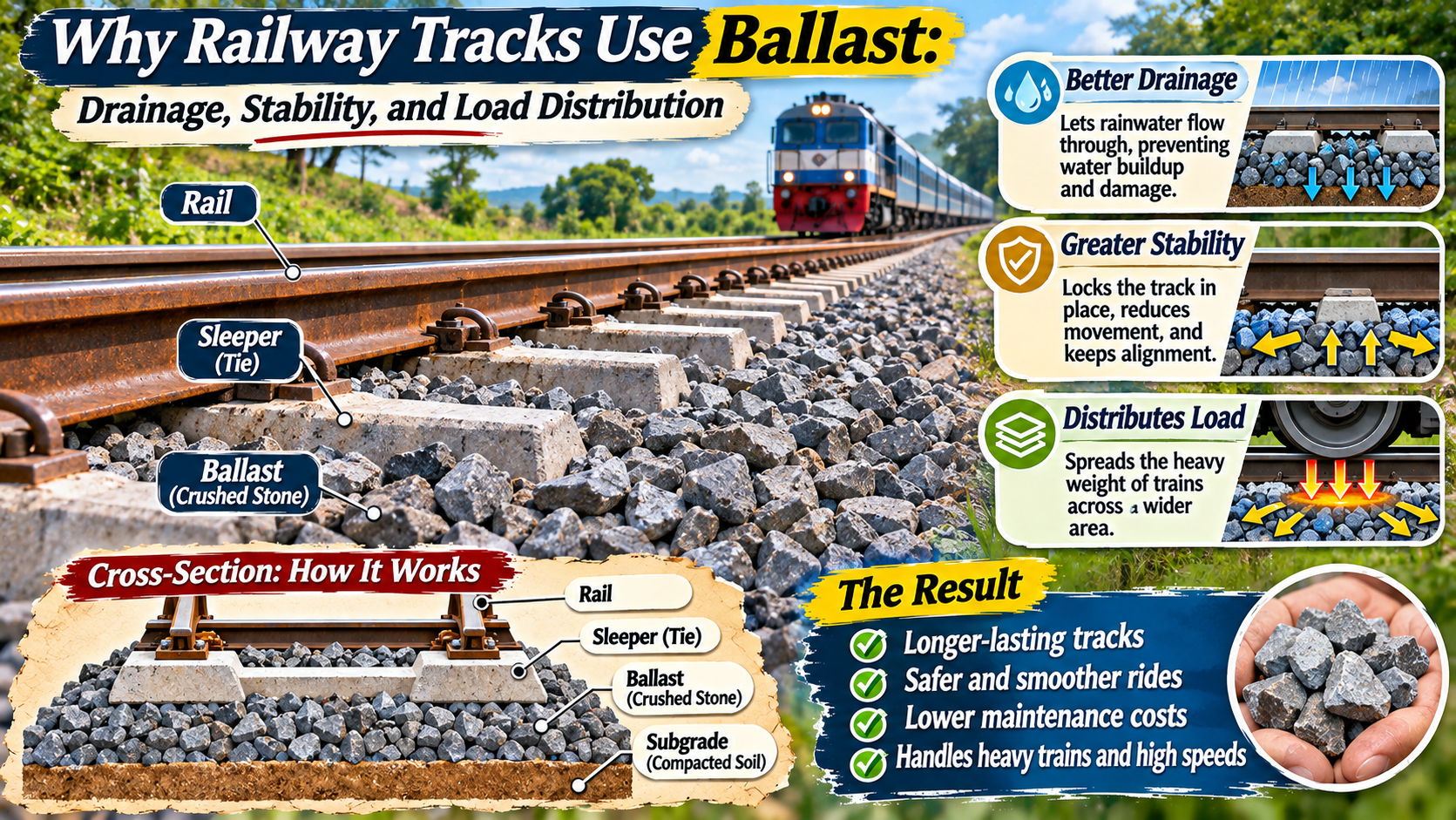
Ballast performs several important functions. It supports the track, helps distribute loads, provides resistance to movement, and allows water to drain away from critical structural layers.
Without a properly designed and maintained foundation, railway tracks can lose their alignment, develop uneven support, and require more frequent repairs.
The importance of ballast becomes especially clear when considering the forces created by heavy trains traveling repeatedly over the same route.
Understanding how ballast works reveals why something as ordinary as crushed rock is essential to many modern railway systems.
What Is Railway Track Ballast?
Railway ballast is a layer of coarse granular material placed beneath and around railway sleepers, also called ties in North America.
It is commonly made from durable crushed rock.
Suitable materials often include hard stone such as granite, basalt, or other aggregates that meet railway engineering requirements.
The exact material depends on local geology, cost, and applicable construction standards.
Unlike ordinary rounded river gravel, railway ballast generally consists of angular particles.
These sharp-edged stones interlock with one another, helping create a stable track foundation.
Ballast is usually placed above additional supporting layers, which may include subballast and the prepared subgrade.
Together, these layers form the railway track foundation.
Understanding the Structure of a Ballasted Railway Track
A conventional ballasted railway track contains several structural components.
Each component performs a different function in supporting and guiding trains.
Not every railway uses exactly the same arrangement.
Layer thicknesses, materials, and construction methods depend on train loads, operating speeds, soil conditions, and engineering standards.
1. Ballast Helps Distribute Heavy Train Loads
Trains apply substantial forces to the rails.
These forces pass through the rail fastenings and sleepers before reaching the ballast.
If the loads were transferred directly into weak soil over a small area, excessive deformation could occur.
The ballast layer helps spread the applied forces over a broader supporting area.
This reduces stress concentrations in the underlying track foundation.
However, ballast does not distribute loads perfectly or uniformly.
Its performance depends on particle arrangement, compaction, layer thickness, sleeper geometry, and the condition of the supporting ground.
Repeated train loading can cause ballast particles to rearrange or break.
Over time, this may lead to settlement and changes in track geometry.
Proper maintenance helps restore the required support conditions.
ENGINEERING PRINCIPLE / LOAD PATH
Train Wheel → Rail → Sleeper → Ballast → Supporting Ground
Each layer helps transfer forces toward the ground while maintaining the track’s required position and structural performance.
2. Ballast Provides Drainage Beneath the Track
Water is one of the most important factors affecting railway track performance.
Rainfall, snowmelt, groundwater, and surface runoff can introduce moisture into the track foundation.
If water remains trapped within the structure, the underlying soil may lose strength.
Excess moisture can also contribute to settlement and deformation.
Clean ballast contains relatively large spaces between its particles.
These spaces allow water to move through the layer more easily than it would through tightly packed fine soil.
Track shoulders, drainage channels, and the shape of the formation help direct water away from the railway.
However, ballast alone cannot solve every drainage problem.
A railway also needs suitable underlying layers and effective surface or subsurface drainage systems.
What Happens When Ballast Becomes Clogged?
Over time, ballast can accumulate fine particles.
These materials may come from broken ballast, surrounding soil, spilled cargo, or other sources.
The accumulation of fines is commonly called ballast fouling.
Fouling reduces the open spaces between stones and can restrict drainage.
It may also change the mechanical behavior of the ballast layer.
In severe cases, maintenance crews may need to clean or replace the affected material.
3. Angular Stones Help Keep the Track Stable
The shape of ballast particles is important.
Angular crushed rock creates mechanical interlocking between neighboring stones.
This interlocking helps the ballast resist movement under repeated train loading.
Ballast also surrounds the sleepers and provides resistance to sideways and lengthwise movement.
This is important because rails and sleepers experience forces from braking, acceleration, temperature changes, and passing trains.
Curved tracks can experience significant lateral forces.
Properly compacted ballast and adequate shoulder support help maintain track alignment.
Rounded stones generally provide less effective interlocking than angular crushed aggregate.
For this reason, particle shape is an important consideration in ballast selection.
4. Ballast Supports Accurate Track Geometry
Railway tracks must maintain appropriate alignment, elevation, gauge, and cross-level.
Even relatively small geometry defects can affect ride quality and increase dynamic forces.
Ballast provides an adjustable foundation that maintenance crews can correct when settlement occurs.
Specialized machines can lift the track and compact ballast beneath the sleepers.
This process is called tamping.
Tamping helps restore support and correct certain track geometry defects.
However, repeated tamping can gradually damage ballast particles.
Railway operators therefore balance geometry correction with longer-term ballast maintenance and renewal.
Why Railways Use Crushed Stone Instead of Ordinary Gravel
Crushed stone is generally preferred because its angular particles can interlock effectively.
Suitable ballast also needs strength and durability.
Particles must withstand repeated loading without excessive crushing or abrasion.
Material quality is important because broken particles can create fines that reduce drainage performance.
Railway specifications may assess properties such as particle size distribution, resistance to fragmentation, shape, and cleanliness.
The goal is to select aggregate that provides long-term support while remaining practical to maintain.
MATERIAL COMPARISON / TRACK FOUNDATION
Strong particle interlocking, good drainage when clean, and suitable resistance to movement.
Particles generally interlock less effectively, potentially reducing resistance to track movement.
How Ballast Helps Manage Repeated Train Vibrations
Passing trains generate dynamic forces that travel through the track structure.
These forces vary with train speed, axle load, track condition, and wheel–rail interaction.
The granular ballast layer responds through particle contact, friction, and small movements.
This behavior can help dissipate some mechanical energy.
However, ballast does not eliminate railway vibration.
Vibration levels also depend on the rails, sleepers, subgrade, nearby soil, and surrounding structures.
In locations where vibration control is particularly important, railways may use additional engineered systems.
These can include resilient components or specialized track designs.
Why Ballast Needs Regular Maintenance
Railway ballast experiences repeated mechanical loading throughout its service life.
Over time, particles can shift, fracture, or become contaminated with fine material.
These changes may reduce drainage capacity and affect track geometry.
Railway maintenance programs therefore include inspections and corrective work.
Common activities include tamping, ballast regulation, cleaning, and renewal.
Maintenance decisions depend on traffic levels, track condition, environmental factors, and operating requirements.
Common Ballast Maintenance Methods
Tamping: Compacts and rearranges ballast beneath sleepers to restore support and geometry.
Ballast regulation: Redistributes ballast to maintain the required track profile and shoulder shape.
Ballast cleaning: Removes accumulated fines and contaminated material where practical.
Ballast renewal: Replaces material that can no longer provide adequate performance.
Ballasted Track Versus Ballastless Track
Not all modern railways use crushed-stone ballast.
Some systems use ballastless track, often called slab track.
These designs support rails using concrete slabs or other engineered structures.
Slab track can provide stable geometry and may require less routine geometry correction under suitable conditions.
However, construction costs can be higher, and repairs or modifications may be more complicated.
Ballasted track remains widely used because it is flexible, familiar, and relatively straightforward to adjust or renew.
The choice depends on project requirements, life-cycle costs, operating conditions, and engineering constraints.
| Feature | Ballasted Track | Ballastless Track |
|---|---|---|
| Primary support | Crushed-stone layer | Concrete or engineered structural system |
| Geometry adjustment | Can be corrected through tamping | Usually requires specialized adjustment methods |
| Routine maintenance | Ballast and geometry maintenance required | Often less frequent geometry correction |
| Construction considerations | Established construction methods | May require higher initial investment |
Environmental Considerations in Railway Ballast
Railway ballast requires large quantities of aggregate.
Quarrying, processing, and transporting crushed stone consume energy and can affect local environments.
Railway engineers therefore consider material durability and service life when selecting ballast.
Long-lasting aggregate can reduce the frequency of replacement.
Some projects investigate recycled or alternative materials, but these must meet appropriate performance and safety requirements.
Good drainage design and maintenance can also help extend the useful life of the track foundation.
Frequently Asked Questions
Why do railway tracks have stones underneath them?
The stones form a ballast layer that supports sleepers, distributes loads, helps drainage, and resists track movement.
Why is crushed stone used instead of sand?
Coarse angular stones provide stronger interlocking and larger drainage spaces than sand, making them better suited to many ballasted track applications.
Does ballast prevent railway tracks from moving?
Ballast provides resistance to movement, but track stability also depends on sleepers, fastenings, rail design, temperature, and overall track condition.
How does ballast help drainage?
Spaces between clean ballast particles allow water to pass through the layer toward suitable drainage paths.
What happens when ballast becomes dirty?
Fine material can clog the spaces between stones, reduce drainage, and affect the mechanical performance of the track foundation.
Do high-speed railways use ballast?
Some high-speed railways use ballasted track, while others use ballastless systems. The choice depends on design requirements and operating conditions.
How often is railway ballast replaced?
There is no universal replacement interval. Ballast life depends on traffic, material quality, drainage, maintenance, and local conditions.
Final Thoughts
Railway ballast may look like an ordinary layer of crushed stone, but it performs several essential engineering functions.
It helps distribute train loads, provides drainage, supports sleepers, and resists track movement.
The angular shape and durability of ballast particles contribute to the stability of conventional railway tracks.
At the same time, ballast requires regular inspection and maintenance because repeated loading and contamination can reduce its effectiveness.
Although modern railway systems sometimes use ballastless construction, crushed-stone ballast remains a practical and widely used foundation for railway infrastructure.
Its continued importance demonstrates how carefully selected materials and relatively simple engineering principles can support complex transportation systems.