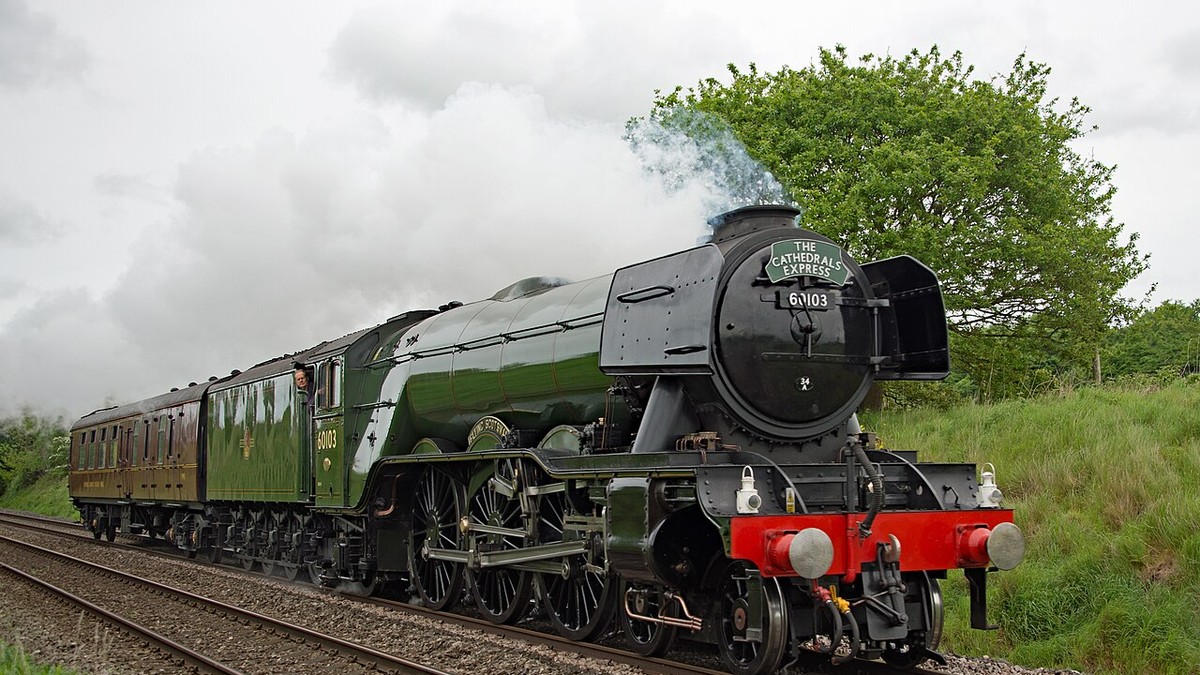
Few mechanical artifacts in industrial history possess the transcendent celebrity and cultural resonance of London and North Eastern Railway (LNER) Class A3 No. 4472 Flying Scotsman. Emerged from the Doncaster Works in February 1923 under the visionary direction of Chief Mechanical Engineer Sir Herbert Nigel Gresley, this 4-6-2 ‘Pacific’ type locomotive became the supreme ambassador of British steam engineering. From inaugurating the first regular non-stop passenger express run between London King’s Cross and Edinburgh Waverley (392.7 miles) to becoming the first authenticated steam locomotive to officially cross the 100-mile-per-hour barrier in 1934, Flying Scotsman represents the zenith of interwar steam passenger design.
🚂 The 1923 Grouping Context
Under the Railways Act 1921 (the ‘Grouping’), over 120 separate British railway companies were consolidated into the ‘Big Four’ on January 1, 1923: the LMS, LNER, GWR, and SR. Flying Scotsman, constructed as Great Northern Railway No. 1472 just as the merger took effect, was selected by the newly formed LNER to showcase British engineering superiority at the 1924 British Empire Exhibition at Wembley, where it was renumbered 4472 and christened after the historic express service it headed.
1. Nigel Gresley’s Engineering Philosophy and the Three-Cylinder Architecture
Sir Nigel Gresley rejected the conventional British two-cylinder and four-cylinder cross-compound arrangements in favor of a specialized three-cylinder simple-expansion design. Gresley recognized that an odd-numbered, three-cylinder configuration arranged at 120-degree crank angles offered decisive thermodynamic and dynamic advantages over standard two-cylinder engines.
First, three cylinders provided six power strokes per driving wheel revolution rather than four, yielding a remarkably continuous, smooth torque curve. This drastically mitigated wheel-slip during low-speed high-tractive starting, enabling the locomotive to launch heavy 500-ton expresses from standing starts without violent surging. Second, the balanced reciprocating forces almost completely eradicated the destructive ‘hammer blow’—the pulsating dynamic impact imposed upon the permanent way by poorly balanced counterweights on driving wheels. This enabled the civil engineering department to permit heavier axle loadings (up to 20 tons) without damaging railheads or bridge girders.
To actuate the central cylinder located directly between the frames beneath the smokebox, Gresley devised his ingenious ‘2-to-1 derived conjugated valve gear.’ Rather than crowding a third set of Walschaerts valve gear inside the cramped space between the main frames—which would have created severe lubrication and maintenance nightmares for running shed fitters—Gresley linked the valve spindles of the two outside cylinders via a cross-lever mechanism with a 2-to-1 ratio. The mathematical motion of the outside valves automatically derived and actuated the exact valve events for the center cylinder with exquisite kinematic precision.
| Technical Parameter | Original Class A1 Specification (1923) | Rebuilt Class A3 Specification (1947) |
|---|---|---|
| Wheel Arrangement | 4-6-2 (Pacific Type) | 4-6-2 (Pacific Type) |
| Cylinder Configuration | 3 Cylinders (20 x 26 inches) | 3 Cylinders (19 x 26 inches) |
| Boiler Working Pressure | 180 psi (1.24 MPa) | 220 psi (1.52 MPa) |
| Driving Wheel Diameter | 6 feet 8 inches (2.032 m) | 6 feet 8 inches (2.032 m) |
| Total Evaporative Heating Surface | 2,930 sq ft | 2,692 sq ft (Higher Superheat) |
| Superheater Surface Area | 525 sq ft (Robinson Type) | 700 sq ft (Elesco Multi-Flue Type) |
| Tractive Effort (@ 85% BP) | 29,835 lbf (132.7 kN) | 32,910 lbf (146.4 kN) |
| Engine & Tender Loaded Weight | 148 Tons 15 Cwt | 156 Tons 10 Cwt (Corridor Tender) |
2. The Non-Stop London-to-Edinburgh Marathon (May 1, 1928)
Throughout the 1920s, the East Coast Main Line (LNER) and the West Coast Main Line (LMS) engaged in fierce commercial competition for Anglo-Scottish passenger traffic. In 1928, the LNER announced an audacious operational gambit: the introduction of a daily, scheduled non-stop express running 392.7 miles between King’s Cross and Edinburgh without a single intermediate station stop.
Under British Board of Trade regulations and physiological limits, a locomotive crew could not safely maintain vigilance and manual physical coal-firing across an eight-hour continuous high-speed run. Because stopping to change crews would destroy the non-stop distinction, Gresley designed the revolutionary ‘Corridor Tender.’ Along the right-hand side of the eight-wheel tender, Gresley incorporated a narrow, enclosed passage 18 inches wide and 5 feet high, sealed with a bellows gangway connecting to the front passenger coach.
At Tollerton, north of York, while the train barreled northward at 65 miles per hour, the relief driver and fireman walked from the front carriage through the corridor tender into the cab, while the working crew relinquished the controls, retreated through the tender, and relaxed in the passenger compartments. Water replenishment without stopping was accomplished via an air-operated water scoop lowered into track troughs situated between the rails at Langley, Newark, Scrooby, and Wiske Moor, vacuuming 3,000 gallons of water into the tender tanks within thirty seconds at full line speed. On May 1, 1928, Flying Scotsman inaugurated the service, completing the run in seven hours and twenty-seven minutes, establishing a world record for the longest non-stop railway journey of its day.
3. Breaking the Three-Digit Frontier: The 100 MPH Record (November 30, 1934)
During the early 1930s, the LNER confronted intense pressure from German State Railways, which had introduced the lightweight diesel-electric Fliegender Hamburger capable of 100 mph sustained cruising. Skeptics within the LNER board argued that steam traction was obsolete and urged the adoption of diesel power.
Gresley remained steadfast in his conviction that steam traction, when optimized with advanced thermodynamic valves, high superheat, and aerodynamic draughting, could match or exceed diesel velocity with vastly superior payload capacity. On November 30, 1934, Gresley organized a high-speed test run with Flying Scotsman (by then rebuilt to Class A3 specifications with a 220 psi boiler) hauling a six-coach dynamometer car test train weighing 207 tons between London and Leeds.
Southbound down the slight 1-in-200 falling gradient approaching Little Bytham near Grantham, driver William Sparshatt opened the regulator fully and advanced cutoff. The mechanical dynamometer clock recorded sustained acceleration: 95 mph, 98 mph, and then, at milepost 90.25, the needle settled decisively at 100.0 miles per hour (160.9 km/h) for six hundred yards. This historic feat represented the first officially authenticated, instrumentally recorded 100 mph achievement by a steam locomotive in world history, disproving claims that steam was incapable of modern high-speed service.
🚂 Thermodynamics of Long-Lap Long-Travel Valves
A paramount mechanical refinement in the transition from Class A1 to Class A3 was the adoption of long-lap, long-travel piston valves. By expanding the valve travel from 4.75 inches to 5.75 inches and increasing steam lap to 1.625 inches, Gresley radically enlarged port openings at short cutoffs. This slashed wire-drawing frictional losses as steam rushed into the cylinders, allowing the engine to run at 70 to 80 mph with regulator wide open and cutoff as low as 15%, conserving immense fuel while unleashing high-speed tractive power.
4. Global Odyssey: The American and Australian Expeditions
Following its withdrawal from British Railways service in January 1963, Flying Scotsman was purchased by flamboyant industrialist Alan Pegler, who spearheaded an exhaustive mechanical restoration at Darlington Works. Pegler embarked on an audacious international goodwill and trade tour across North America between 1969 and 1972.
Equipped with an American-style cowcatcher, chime whistle, high-intensity bell, and buckeye couplers, Flying Scotsman traversed 11,530 miles across the United States and Canada, steaming from Boston to Atlanta, Dallas, and through the Rocky Mountains to San Francisco. Despite immense public acclaim, the venture incurred staggering financial deficits, leading to the locomotive being impounded in California until British construction magnate Sir William McAlpine intervened in 1973, clearing debts and repatriating the engine to the UK.
In 1988–1989, Flying Scotsman embarked on a second international triumph, visiting Australia for the national bicentenary celebrations. Operating over 28,000 miles across the Australian standard-gauge network, the locomotive completed the longest non-stop steam run in history on August 8, 1989: 422 miles from Parkes to Broken Hill through the Outback without taking on water, cementing its global immortal status.
5. The National Railway Museum Restoration and Engineering Conservation
In April 2004, following an emergency national fundraising campaign supported by the National Heritage Memorial Fund and public donations, Flying Scotsman was acquired for the nation by the National Railway Museum (NRM) in York for £2.3 million.
Between 2006 and 2016, the locomotive underwent the most exhaustive, technically rigorous engineering overhaul ever performed on a heritage steam locomotive. Disassembled down to its bare frame plates at the Riley & Son engineering works in Bury, engineers discovered severe fatigue cracking, cylinder misalignment, and metallurgical degradation accumulated over nine decades of relentless mainline running.
The conservation team deployed advanced ultrasonic non-destructive testing (NDT), finite-element computer stress modeling, and optical laser alignment to true the locomotive’s main frames. A brand-new all-welded high-tensile boiler was constructed adhering to strict modern pressure-vessel safety standards, alongside new hornblocks, axle bearings, and a rebuilt conjugated valve mechanism. In February 2016, Flying Scotsman returned triumphantly to mainline operation, resplendent in authentic BR Brunswick Green livery.
6. Cultural Immortality and Mechanical Significance
Flying Scotsman stands as far more than an evocative Victorian or Edwardian relic; it is the ultimate living embodiment of British industrial mastery at its apogee. In an era before wind-tunnel aerodynamic streamlining dominated industrial design, Gresley’s A3 captured the absolute aesthetic equilibrium of mechanical power: a massive, purposeful boiler barrel, exquisitely balanced three-piece splashers covering tall driving wheels, and clean, uncluttered footplates.
It bridged the nineteenth-century world of heavy iron and coal-fired sweat with the twentieth-century world of precision thermodynamics, scientific dynamometer testing, and scheduled intercity speeds. Today, preserved in active mainline steam condition by the National Railway Museum, Flying Scotsman continues to inspire engineers, historians, and generations of admirers across the globe, a roaring steel testament to the enduring majesty of steam locomotion.
Gresley Conjugated Valve Gear & A3 Aerodynamic Dynamometer Records
The enduring fame of the LNER Class A3 Pacific locomotives—exemplified by No. 4472 Flying Scotsman—rests upon the sophisticated mechanical engineering of Sir Nigel Gresley. Designed to haul the premier 392-mile non-stop express from London King’s Cross to Edinburgh Waverley in under six hours, the A3 Pacifics represented the zenith of British three-cylinder express passenger power. Gresley avoided the mechanical complexity of an internal valve gear inside the locomotive frames by inventing the patented Gresley conjugated 2-to-1 valve motion. This mechanical linkage utilized two external sets of Walschaerts valve gear driven by the outside cylinders to actuate the central cylinder’s piston valve through a pivoting cross-lever and equalizing arm, eliminating an entire internal valve gear assembly and saving substantial mechanical weight.
Thermodynamically, the A3 class featured a round-topped firebox with a wide combustion chamber and 41.25 square feet of grate area, fed by high-grade Yorkshire soft coal. Gresley incorporated the Robinson superheater, later upgraded to the 43-element Type A superheater, which raised steam temperatures to over 650°F (343°C). Superheating eliminated cylinder wall condensation, ensuring that steam entered the 19-inch diameter cylinders in an expansive dry gaseous state. The 220 psi boiler pressure acted upon 6 ft 8 in driving wheels, providing exceptional acceleration and sustainable high-speed cruising above 85 mph across the water troughs and rolling gradients of the East Coast Main Line.
🚂 The Corridor Tender: Solving the 392-Mile Non-Stop Dilemma
In 1928, to fulfill the LNER’s promise of an unbroken 392-mile non-stop run without crew fatigue, Gresley designed the revolutionary eight-wheel corridor tender. The tender housed 9 tons of coal and 5,000 gallons of water, with a 5-foot-high, 18-inch-wide enclosed corridor running along the right-hand side. While traveling at 70 mph, the relief driver and fireman walked from the front passenger carriage through the vestibule gangway and tender corridor to relieve the footplate crew without stopping the train. Water scoops dipped into track troughs at Newark, Scrooby, and Lucker replenished the boiler on the move.
Archival records from the 1934 dynamometer car trials document the monumental achievement of Flying Scotsman on November 30, 1934. Hauled by driver William Sparshatt and fireman R. Webster, No. 4472 attained a fully authenticated maximum speed of 100.0 miles per hour (160.9 km/h) on the descent from Stoke Summit toward Essendine. The dynamometer car behind the tender recorded a drawbar pull of 2.5 tons at 100 mph, with the boiler generating over 1,500 indicated horsepower. This marked the first officially authenticated 100 mph run by a steam locomotive in Great Britain, refuting continental claims and establishing the A3 class as a global icon of high-speed mechanical engineering.
| Mechanical Parameter | Gresley Class A1 (1923 Baseline) | Gresley Class A3 (1927–1934 Rebuild) | Class A4 Streamlined Pacific (1935) |
|---|---|---|---|
| Boiler Pressure | 180 psi (1.24 MPa) | 220 psi (1.52 MPa) | 250 psi (1.72 MPa) |
| Cylinder Dimensions | 3 cylinders: 20 x 26 in | 3 cylinders: 19 x 26 in | 3 cylinders: 18.5 x 26 in |
| Valve Gear Type | Gresley-Walschaerts Conjugated | Gresley-Walschaerts Conjugated | Gresley-Walschaerts Conjugated |
| Total Heating Surface | 3,455 sq ft | 2,698 sq ft (Optimized tube spacing) | 3,325 sq ft (Combustion chamber) |
| Tractive Effort | 29,835 lbf | 32,910 lbf | 35,455 lbf |
| Authenticated Max Speed | 89 mph (1924) | 100.0 mph (Flying Scotsman, 1934) | 126.0 mph (Mallard, 1938) |
Following nationalization and eventual withdrawal from British Railways revenue service in 1963, Flying Scotsman was purchased by preservationist Alan Pegler. Its subsequent historic promotional tours across North America (1969–1972) and Australia (1988–1989)—where it set a world record for the longest non-stop steam locomotive run of 422 miles—solidified its status as the most universally recognized locomotive in railway history.