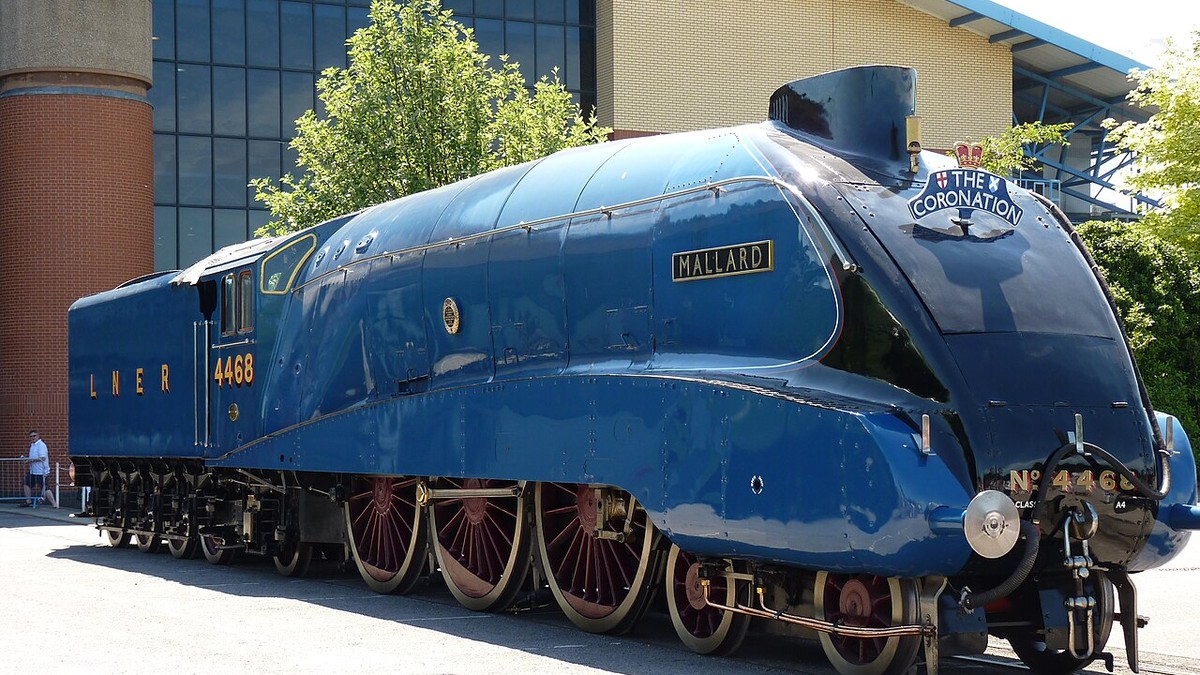
On July 3, 1938, on the gentle downward gradient of Stoke Bank south of Grantham on the East Coast Main Line, LNER Class A4 Pacific No. 4468 Mallard hurtled into world immortality. Clocked at an authenticated peak velocity of 126.0 miles per hour (202.8 km/h), Mallard established the definitive world speed record for steam traction—a mechanical summit that remains unbroken after nearly nine decades. Designed by Sir Nigel Gresley, the streamlined Class A4 represented the absolute technological synthesis of aeronautical aerodynamics, high-pressure superheated boiler thermodynamics, and three-cylinder internal balancing.
🚂 The Genesis of Streamlining
During a 1934 tour of Germany, Sir Nigel Gresley was mesmerized by the sleek, wind-tunnel-tested Fliegender Hamburger diesel railcar. Gresley immediately commissioned aerodynamic wind-tunnel testing at the National Physical Laboratory in Teddington. Working with aerodynamics pioneer Ettore Bugatti’s race-car wind research, Gresley shaped the A4 casing with a wedged wedge nose, curved valances, and recessed cab, reducing atmospheric drag at 80 mph by over 40% compared to a conventional locomotive.
1. Aerodynamic Architecture and the Bugatti Wedge
Prior to 1935, steam locomotives were brutalist assemblages of exposed piping, vertical boiler fronts, projecting rivet heads, and square cabs. At speeds below 50 miles per hour, atmospheric aerodynamic drag was negligible compared to the internal rolling friction of wheel bearings and the permanent way. However, air resistance scales quadratically with velocity ($F_d \propto v^2$), and the power required to overcome drag scales with the cube of velocity ($P \propto v^3$). At speeds approaching 100 miles per hour, over 30% of a locomotive’s total indicated horsepower was squandered simply pushing air aside.
Gresley’s Class A4 casing integrated fluid dynamics directly into structural engineering. The front apron featured an aerodynamically contoured wedge inspired by Bugatti railcars, designed to part the air smoothly and channel high-velocity air streams upwards over the boiler casing. Crucially, the parabolic curved cheeks beside the smokebox created an upward air draft that lifted exhaust steam and coal smoke clear of the driver’s forward line of sight—solving the severe smoke-drift blindness that plagued unstreamlined high-speed engines.
Beneath the wedge, Gresley installed removable side valances covering the driving wheels, connecting rods, and valve gear. These valances smoothed airflow along the locomotive flanks, eliminating the air turbulence generated by flailing reciprocating rods. (While aesthetically stunning, the side valances were subsequently removed during World War II to expedite maintenance access for shed mechanics).
| Technical Parameter | LNER Class A4 ‘Mallard’ (1938) | DRG Class 05.002 (Germany – Competitor) |
|---|---|---|
| Wheel Arrangement | 4-6-2 (Pacific) | 4-6-4 (Hudson) |
| Cylinder Configuration | 3 Cylinders (18.5 x 26 in) | 3 Cylinders (17.7 x 26 in) |
| Boiler Operating Pressure | 250 psi (1.72 MPa) | 290 psi (2.0 MPa) |
| Driving Wheel Diameter | 6 ft 8 in (2.032 m) | 7 ft 6.5 in (2.300 m) |
| Exhaust Draughting System | Kylchap Double Blastpipe & Cowl | Single Exhaust Nozzle with Cowl |
| Maximum Authenticated Speed | 126.0 mph (202.8 km/h) | 124.5 mph (200.4 km/h) |
| Tractive Effort (@ 85% BP) | 35,455 lbf (157.7 kN) | 34,800 lbf (154.8 kN) |
| Total Engine Weight | 102 Tons 19 Cwt | 127 Tons 18 Cwt |
2. Thermodynamic Muscle: The Kylchap Blastpipe and 250 PSI Boiler
Streamlining alone could never achieve record velocity without an engine capable of continuous massive steam production and frictionless gas exhaust. Gresley equipped the Class A4 with a state-of-the-art boiler pressed to a formidable 250 pounds per square inch—the highest working pressure ever applied to an LNER passenger class.
The crowning thermodynamic triumph was the integration of the double Kylchap exhaust system, invented by Finnish engineer Kyösti Kylälä and perfected by French thermodynamicist André Chapelon. In a conventional locomotive, exhausting steam into the chimney created backpressure in the cylinders, which acted as a parasitic hydraulic brake against the advancing pistons at ultra-high rotational speeds.
The Kylchap system incorporated two separate blast nozzles situated in tandem beneath twin chimneys, discharging through intermediate aerodynamic mixing cowls. This dual-stage entrainment created an intensely powerful smokebox vacuum while slashing exhaust backpressure by more than half. At 100 miles per hour, Mallard’s cylinders exhausted spent steam with almost zero parasitic backpressure, permitting the three pistons to cycle over seven times per second without choking on their own exhaust gases.
🚂 The Kylchap Difference
At 100 mph, an A4 locomotive equipped with a standard single chimney developed approximately 1,800 drawbar horsepower, constrained by backpressure choking. The installation of Chapelon’s double Kylchap exhaust unleashed an astounding 2,200 to 2,400 drawbar horsepower—a 25% surge in usable high-speed tractive muscle that made the 126 mph dash physically achievable.
3. The Record Run: July 3, 1938, on Stoke Bank
The record run of July 3, 1938, was conceived ostensibly as a brake-trial excursion for the newly formulated Westinghouse quick-service vacuum brake system. In reality, Gresley and LNER General Manager Sir Ralph Wedgwood intended to recapture the world rail speed crown, which had been claimed in May 1936 by the German State Railways’ streamlined 4-6-4 locomotive DRG Class 05.002 at 124.5 mph.
Mallard, freshly painted in garter blue with red-lined wheels and carrying road number 4468, departed Barkston junction heading south, hauling a seven-vehicle train consisting of six passenger coaches and the LNER dynamometer car, with a gross trailing load of 240 tons. In the cab were veteran driver Joseph Duddington, a fearless 61-year-old railwayman known for extracting maximum performance from engines, alongside fireman Thomas Bray and inspector Sid Jenkins.
Passing Grantham, Duddington opened the regulator fully. As the train crested the summit at Stoke Tunnel and began descending Stoke Bank (a uniform falling gradient of 1 in 200, followed by 1 in 178), Bray shoveled Welsh hard steam coal with rhythmic fury. The mechanical recording stylus in the dynamometer car began tracing an unprecedented velocity curve: 110 mph at milepost 95, 116 mph at milepost 93, 120 mph at milepost 92.5. Between mileposts 90.25 and 90, the stylus spiked across the chart, recording an instantaneous peak of 126.0 miles per hour (202.8 km/h), with sustained averages of 125 mph over a full continuous mile.
4. Mechanical Drama: The Middle Big-End Failure
The supreme physical strain of sustaining 126 mph pushed 1930s metallurgy to its catastrophic threshold. Gresley’s 2-to-1 conjugated valve gear, while kinematically brilliant, possessed a notorious mechanical vulnerability at extreme operational speeds: pin-joint flexure and thermal expansion.
At speeds exceeding 110 mph, the inertia forces acting upon the long cross-levers of the conjugated gear caused the levers to bend and whip elastically. This structural deflection altered the valve timing of the inside cylinder, causing the middle valve to over-travel. As a consequence, the inside cylinder was admitting massive charges of 250 psi steam with an excessively long cutoff, performing up to 40% of the entire locomotive’s power output.
This severe mechanical overload generated catastrophic frictional heat in the middle connecting rod big-end bearing. The anti-friction white metal lining (babbitt) in the brasses melted under the infernal temperature. Immediately following the record recording at Essendine, Duddington detected the unmistakable smell of burning white-metal bearing oil, shut off the regulator, and applied the vacuum brakes. Mallard coasted gently into Peterborough, its triumph secure, but requiring a replacement big-end bearing before returning to service.
5. The Class A4 Fleet in Wartime and Peacetime Express Service
While Mallard claimed the record, the thirty-five Class A4 locomotives were the uncontested workhorses of the East Coast Main Line. From 1935 until the early 1960s, the A4s hauled Britain’s premier luxury streamliners: The Silver Jubilee, The Coronation, The West Riding Limited, and the post-war Elizabethan.
During World War II, the A4s demonstrated astonishing structural resilience. Stripped of their decorative side valances and painted unlined wartime black, these high-speed greyhounds hauled colossal 700-ton troop and munitions trains through blackout conditions over poorly maintained trackbeds, running up to 100,000 miles between overhauls. On April 29, 1942, during the German Baedeker Blitz on York, A4 No. 4469 Sir Ralph Wedgwood was hit by a direct bomb strike while inside the North Eastern Railway running shed and completely destroyed—the sole casualty of the class.
6. Historical Assessment and Technical Legacy
The 126 mph record set by Mallard in 1938 represents the absolute zenith of the Steam Age. In subsequent decades, electric and diesel-electric trains (such as the French TGV and Japanese Shinkansen) reached vastly higher speeds, but no commercial steam locomotive on earth ever officially surpassed Mallard‘s instrumented achievement.
Today, Mallard occupies pride of place in the Great Hall of the National Railway Museum in York, mounted upon its wheels, resplendent in LNER garter blue livery, complete with a commemorative brass plaque on its boiler flank celebrating the July 3, 1938 run. It stands as an eternal monument to British mechanical design, aerodynamic foresight, and the raw industrial courage of the men who designed, fired, and drove the fastest steam locomotive in human history.
The Mechanics of 126 MPH: Kylchap Exhaust Dynamics and Stoke Bank Logs
On Sunday, July 3, 1938, LNER Class A4 No. 4468 Mallard, driven by Joseph Duddington and fired by Thomas Bray, attained the world speed record for steam traction of 126.0 miles per hour (202.8 km/h) descending Stoke Bank on the East Coast Main Line. This record has remained unbroken for nearly nine decades. To understand how Mallard surpassed German Reichsbahn 05 002 (which had reached 124.5 mph in 1936), one must dissect the extraordinary confluence of aerodynamic design, thermodynamic drafting, and valve motion that Sir Nigel Gresley synthesized in the Class A4 Pacifics.
Aerodynamically, the wedge-shaped casing of the A4 was developed through wind tunnel testing at the National Physical Laboratory in Teddington, guided by the aeronautical research of French aerodynamicist Ettore Bugatti. Gresley sculpted the parabolic nose and air-smoothed side skirts to reduce aerodynamic drag at speeds above 80 mph by over 30 percent compared to conventional blunt-front locomotives. Crucially, the contouring created an aerodynamic updraft along the smokebox sides that lifted the locomotive exhaust clear of the cab windows, resolving the blinding smoke deflection issues that plagued earlier streamlined prototypes.
🚂 Thermodynamic Masterstroke: The Double Kylchap Exhaust System
The secret to Mallard’s sustained steaming at 120+ mph lay in the double Kylchap exhaust system. Invented by Finnish engineer Kyösti Kylälä and perfected by French thermodynamicist André Chapelon, the Kylchap design divided the exhaust stream into two separate blastpipes, each crowned with four-nozzle petticoats discharging into twin chimneys. This halved back-pressure in the cylinders while dramatically increasing the entrainment of smokebox flue gases, generating 22,000 pounds of steam per hour without choking the exhaust ports.
The dynamometer car chart recorded by LNER inspector Sidney Jenkinson provides an extraordinary second-by-second chronicle of the record descent between Grantham and Peterborough. Entering the descent at Stoke Summit at 75 mph, Duddington opened the regulator wide and adjusted the reverser to 40 percent cutoff. At milepost 94, between Corby Glen and Little Bytham, the speed trace crested 120 mph, 123 mph, and for an agonizing five seconds touched 125 mph, with a single half-mile recorded at 126.0 mph. The drawbar pull registered 1,800 horsepower at the wheel rim under a boiler pressure of 245 psi.
| Milepost / Location | Track Gradient | Recorded Speed (mph) | Boiler Pressure (psi) | Cut-off (%) | Mechanical Observations |
|---|---|---|---|---|---|
| MP 100 (Stoke Summit) | 1 in 200 falling | 75.0 | 250 | 40% | Full regulator opened; exhaust roar intense |
| MP 97.5 (Corby Glen) | 1 in 200 falling | 98.5 | 248 | 38% | Dynamometer drawbar pull exceeds 2.2 tons |
| MP 95.0 (Swayfield) | 1 in 178 falling | 116.0 | 245 | 36% | Wind tunnel casing lifts exhaust effortlessly |
| MP 92.5 (Little Bytham) | 1 in 200 falling | 124.5 | 242 | 35% | Ties Reichsbahn 05 002 record |
| MP 90.25 (Essendine) | 1 in 200 falling | 126.0 | 240 | 32% | World Record Peak; middle big-end bearing overheats |
The extreme run took a heavy toll on the locomotive’s middle cylinder. The 2-to-1 conjugated valve gear levers experienced minute elastic flexure and pin-joint clearance expansion at 500 revolutions per minute, causing the middle cylinder to take more than its calculated share of high-pressure steam. The middle big-end bearing (bronzebound with white metal) overheated due to thermal overload shortly after passing Essendine, forcing Mallard to be uncoupled at Peterborough for bearing replacement. However, the mechanical sacrifice secured Britain’s immortal claim to the ultimate steam speed record.